Tuesday, June 23, 2009

Refuting Arctic Misconceptions and Misinformation

On 22 June 2009, the London-based Royal United Services Institute (RUSI) published a noteworthy article by Alastair Cameron, “The Arctic Uncovered: Refuting the Last Colonial Grab Theory.”  The article (summarized here) appears in the institute’s monthly Newsbrief and is available for purchase at the RUSI website.

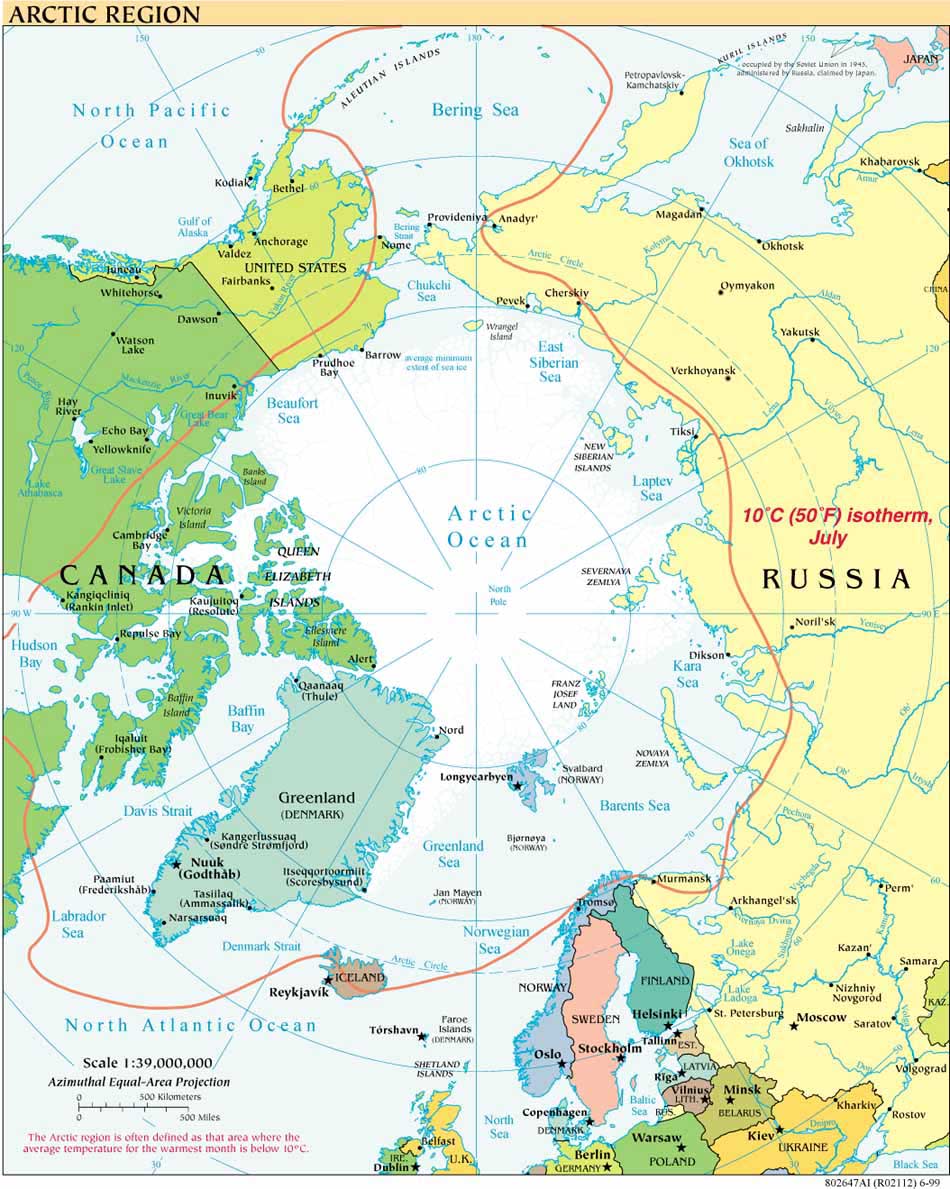
The article makes a short but useful contribution to correcting the rampant misconceptions in the media and elsewhere that the circumpolar Arctic states are heading for conflict or engaged in some form of land grab.  Cameron disagrees that an “energy free-for-all” is underway in the Arctic, pointing to the fact that many of the major petroleum fields identified by the USGS in recent studies are believed to be within Russia’s EEZ.  He lays out the orderly legal process by which states are gathering data under the Law of the Sea Convention for submission to the Commission on the Limits of the Continental Shelf; and speaks of “spirit of international co-operation which has so far been fostered through the Arctic Council and the Ilulissat Declaration.”  He counters perceptions of a military buildup by speaking of the special challenges in the Arctic, observing that these are “best tackled in partnership” yet also speaks of the special and difficult relationship between NATO and Russia, querying what role the alliance should have in the High North.  The complete article expands cogently but significantly on each of these points.


Camreron is Head, European Security Programme, of RUSI, which is self-described as an “independent think tank engaged in cutting edge defence and security research.”  RUSI is based in London, with offices in Doha, Qatar and Washington, D.C.


Tuesday, June 16, 2009

Rep. Young introduces Bill HR 2865 in US House proposing increased icebreaker capacity

On June 12, 2009, US Representative Don Young ( R ) Alaska  introduced the HR 2865 Arctic Marine Shipping Assessment Implementation Act of 2009 in the US House of Representatives.  

The Arctic Marine Shipping Assessment (AMSA)is a negotiated document of the Arctic Council approved by its Ministers at Tromsø, Norway, on April 29, 2009.   AMSA is a comprehensively researched and detailed and usefully presented study of the multiple issues arising from melting ice and increasing shipping in the Arctic Ocean.  AMSA lays out specific recommendations in three broad areas: Enhancing Arctic Marine Safety, Protecting Arctic People and the Environment, and Building the Arctic Marine Infrastructure. 

Among the  “Findings” in the Bill, HR 2865, are that:

 “(7) The United States has continuing research, security, environmental, and commercial interests in the Arctic region that rely on the availability of icebreaker platforms of the Coast Guard. The Polar Class icebreakers commissioned in the 1970s are in need of replacement.”


and, that


“(9) Building new icebreakers, mustering international plans for aids to navigation and other facilities, and establishing coordinated shipping regulations and oil spill prevention and response capability through international cooperation, including the approval of the International Maritime Organization, requires long lead times. Beginning those efforts now, with the completion of an Arctic Marine Shipping Assessment by the eight-nation Arctic Council, is essential to protect United States interests given the extensive current use of the Arctic Ocean and adjacent seas by vessels of many nations.”


Importantly, the Bill places these icebreaking capacity questions in the international framework provided by the International Maritime Organization and emphasizes the need for circumpolar agreements to coordinate activities amongst the Arctic coastal and other seafaring states:


“SEC. 3. INTERNATIONAL MARITIME ORGANIZATION AGREEMENTS.

To carry out the purpose of this Act, the Secretary of the department in which the Coast Guard is operating shall work through the International Maritime Organization to establish agreements to promote coordinated action among the United States, Russia, Canada, Iceland, Norway, and Denmark and other seafaring and Arctic nations to ensure, in the Arctic—

(1) placement and maintenance of aids to navigation;

(2) appropriate icebreaking escort, tug, and salvage capabilities;

(3) oil spill prevention and response capability;

(4) maritime domain awareness, including long-range vessel tracking; and

(5) search and rescue.”


See also this unofficial Coast Guard blog entry on the proposed bill.

Wednesday, June 10, 2009

Alaska and Law of the Sea Convention: Senators Begich and Murkowski, Governor Palin, and the Alaskan Legislature all call for ratification of UNCLOS

At the opening day of the 3rd Symposium on the Impacts of an Ice-Diminishing Arctic on Naval and Maritime Operations, sponsored by the National Ice Center and the US Arctic Research Commission, Senator Mark Begich (D-Alaska) called for ratification of the Law of the Sea Convention in his speech to the conference, as did Senator Lisa Murkowski (R-Alaska) in a letter read on her behalf.  Senator Begich proposed four additional policy recommendations, including U.S. ratification of the Stockholm Convention on Persistent Organic Pollutants, designation of a US “Arctic Ambassador”, more investment in arctic science and, finally, strengthening arctic infrastructure, including “replacement of America’s aging ice-breakers, ensur[ing] that new Virginia class submarines are fully Arctic capable and new Coast Guard facilities from which to base aerial surveillance and emergency response capabilities” (from the related press release).

 Over the past few months, Alaska’s governor and Legislature have also made separate calls for the U.S. Senate to ratify the Law of the Sea Convention.  Governor Sarah Palin (R), spoke recently in a radio talk show of “having to do some educating there in conservative circles” about the importance of the treaty and reiterated that the U.S. has “got to be a player” by joining the Convention.  In May, the Alaska Legislature passed Joint Resolution JJR 222, which details Alaska’s particular interest in US ratification of the treaty.  Caitlyn Antrim, of OceanLaw.Org, has reported on both developments more extensively in her daily email service, saying of the Joint Resolution that it “was introduced on March 2nd, 2009, passed the House on April 8th, the Senate on April 16, was enrolled and transmitted to the Governor on May 27th.  Hearings were held, out of state witnesses testified and the issue was debated in both houses, all in a period of less than three months. ”

The NIC/USARC conference at the US Naval Academy in Annapolis continues for two more days (June 9-11).  For more information now, visit the conference website.  Of special note is that of the speakers at the Symposium's opening day who mentioned the Law of the Sea Convention, every one of them called for U.S. ratification. These included the Hon. Dr. Jane Lubchenco, Under Secretary of Commerce for Oceans and Atmosphere and National Oceanic and Atmospheric Administration (NOAA) Administrator, and Admiral Thad W. Allen, Commandant, U.S. Coast Guard (USCG).

Friday, May 29, 2009

Cooperation, not conflict, in the Arctic: Postcript to COLP Conference in Seward; Conference Presentations posted

As a postscript to the previous entry regarding Changes in the Arctic Environment and the Law of the Sea, the 33rd annual conference of The Center for Oceans Law and Policy (COLP), it is important to broadcast at least one message emphasized repeatedly by conference participants. That message is that there is great cooperation in the Arctic Ocean by littoral states, especially regarding submissions to the Commission on the Limits of the Continental Shelf and in managing existing disagreements regarding maritime boundaries.

John Norton Moore, Director of COLP, in an interview for Alaska Public Radio, emphasized “very substantial cooperation at an operational level, for example Coast Guard to Coast Guard and that governments are working closely together to try to resolve the remaining issues of boundary problems, for example."  Moore emphasized that the eight arctic nations are  “working on cooperative solutions.”  This message was reiterated by Rear Admiral Arthur E Brooks, Commander, 17th USCG  District,  in his description of cooperation between the U.S. and Canadian Coast Guards and by the many diplomatic representatives in attendance.  For a related story from the Canadian perspective see the Petroleum News coverage of a Commonwealth North forum in Anchorage last week (discussing Canada's joint Arctic Ocean surveying with the U.S. and a separate memorandum of understanding with Denmark for joint surveying, as well as Canada's exchange of scientific data about Arctic Ocean ridges with Russia).

Powerpoint presentations from the Seward meeting are already posted on the COLP conference website; the papers will appear in the ongoing series of COLP conference reports published by Brill.  The conference website also provides conference notes prepared by student rapporteur Lisa Campion of Vermont Law School, who is interning this summer at Trustees for Alaska  and is a member of the VLS Institute for Energy and the Environment research team.  Note: the book referenced in her notes on Ted McDorman’s talk is Transit Management in the Northwest Passage: Problems and Prospects, Cynthia Lamson and David L. VanderZwaag (eds), Cambridge University Press 1988 (ISBN 978-0-521-09337-8)

Of particular note for continental shelf mapping is the presentation by Brian Van Pay, Maritime Geographer with the U.S. Department of State Office of Ocean and Polar Affairs.  His talk provided a comprehensive overview of the status of each arctic state’s preparations for and submissions to the Commission on the Limits of the Continental Shelf  (sketched in much less detail here).   The presentations from the session dedicated to Continental Shelf Limits and Jurisdiction (offering a Canadian, United States, Danish and Russian perspective) are also available at the COLP conference web site.

Icebreaking into the Arctic

The USCGC HEALY embarked Barrow, Alaska, in August 2008 to map the US extended continental shelf, or ECS, in the Arctic Ocean (HLY 0805). Healy sailed again from 7 August to 16 September, 2009 (HLY 0905) to continue ECS mapping, joining with the Canadian icebreaker, the Louis S. St.-Laurent. The two vessels mapped together again in 2010 (see HLY1002) and 2011 (HLY1102).

As the only law professor on the science crew, I was along on HLY 0805 and 0905 to better understand
the science behind the legal process that the UN Convention on the Law of the Sea establishes for states making ECS submissions. As to why the US is mapping now, even though it has not yet acceded to the Convention, read on both here, and in the Law of the Sea notes below.

Thanks to
Vermont Law School and especially to Larry Mayer, Director of the University of New Hampshire's Center for Coastal and Ocean Mapping, for making my part in the trip possible.
Thanks, as well, to Adriane Colburn, for opening new windows on and for the deep.